
Regular decision deadlines for January 2027 look comfortably far away in late October. They are not. Most schools set those deadlines inside the first two weeks of January, and the work that makes those two weeks calm happens in November: the final list, the recommendation letters, the funds forms. December panic is just November work that got postponed. This plan spreads the season across the next ten weeks, one month at a time, and it runs on a single habit. Every program on your list gets its own checklist in DocCheck, generated before the work starts, not after it.
Regular decision deadlines January 2027: the window you are aiming at
Admissions calendars for fall 2027 entry put regular decision deadlines between January 1 and January 15, with decisions arriving from March into early April (Spark Admissions keeps a running summary of the cycle). Early Decision II lands in the same window: January 1 at Vanderbilt and Wake Forest, January 4 at the University of Chicago, January 5 at Wellesley and Boston University, and January 15 at Tulane and Carleton, per Summit Prep's deadline roundup. College Board BigFuture pages tell the same story at January 15 schools such as RIT, Providence College, Colorado College and Reed College.
So a typical list is not one deadline. It is three or four dates inside a fortnight, plus aid forms riding on the same days, and the labels matter: some of those January dates are priority deadlines and some are final, which our priority deadline vs final deadline guide pulls apart. The full date picture sits in our rundown of university application deadlines 2027. Plan to the earliest date on your list, and the rest becomes slack.
Rest of October: lock the list and generate every checklist
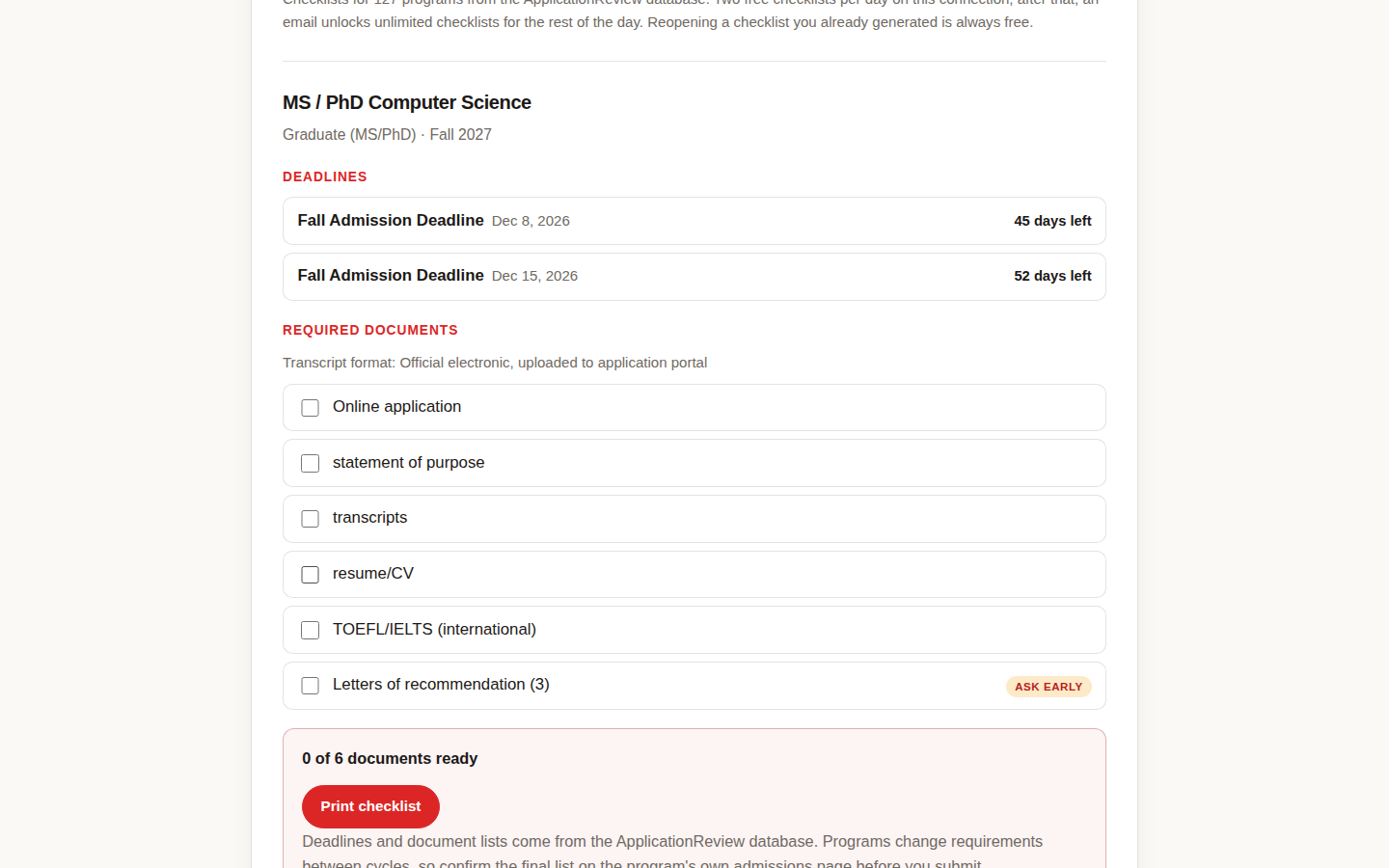
This week is for decisions, not documents. Cut the list to the schools you will actually finish, write down the exact deadline for each one, and then generate its checklist. DocCheck builds one tracker per program: the deadlines first, labelled by the exact type the program publishes and counting down live, then the document list that program requires. The picker holds 127 programs drawn from the wider ApplicationReview deadline database of 3,305 programs. All 127 carry dated deadlines, 119 carry document lists, and 75 record how many recommendation letters the program wants.
Two practical notes. Generating a checklist for a new program counts against a allowance of two new programs a day, so a long list takes a few days to build out. Reopening a program you already generated is available, and your checkmarks save in the browser between visits. Printing a checklist shows only the tracker, which is the version worth pinning above a desk. Build the trackers now, and November becomes execution instead of archaeology.
November: ask for the letters before the December crowd
Recommendation letters are the one part of an application you do not control, so they get requested first. Teachers and counselors write dozens of these in December. A November request, with the exact deadline from your checklist and a short brag sheet attached, is both politer and more likely to land on time. Check each program's letter count in DocCheck before you ask, because the dataset records it for 75 of the 127 programs and the number is not the same everywhere: two letters at one school, three at another, an optional extra somewhere else.
Send each recommender the exact date and the school name, not a season. A vague sometime-in-January produces vague energy; a named date on a named portal produces a letter. Our guide to LOR strategy and recommendation trackers covers who to ask and how to brief them. Then tick the request off on the tracker and set the follow-up for early December, while a nudge is still friendly.
November: file the CSS Profile and the FAFSA while the portals are quiet
Funds forms have their own deadlines, and the CSS Profile deadline at most colleges is the application deadline itself, sometimes earlier. Barnard College's financial aid office, for example, sets its regular decision aid deadline at January 15, 2027, covering the FAFSA, the CSS Profile and the supporting documents together (Barnard's official aid deadlines). Treat every school on your list as if its aid deadline matches its application deadline until you have checked otherwise.
Both forms are already open. The College Board opened the 2027-28 CSS Profile on October 1, 2026 (CSS Profile filing guide), and the 2027-28 FAFSA launched at studentaid.gov on September 23, 2026, a few days ahead of the October 1 date set in law (NerdWallet's FAFSA deadline tracker). The College Board's advice is to submit the CSS Profile at least two weeks before your earliest deadline, which turns a January 1 school into a mid December aid submission. Filing in November makes that arithmetic boring, which is the goal.
December: essays in deadline order, and the paperwork schools send for you
Write the main essay first, while there is still time to let it sit and reread it cold. Then work the supplements in deadline order, not in order of how much you like the school: the January 1 supplements get December's first weekends, the January 15 ones get the last. The season view in seven ways to use DocCheck shows how to keep one tracker per program honest while you do this.
Two items are not yours to submit, but they are still yours to chase. Your school sends the mid year report with first semester grades once the term ends, and transcripts go out in the format each program records. Both sit on your DocCheck document list where the dataset records them. Confirm in December that your school office has every destination, because a transcript sent to the wrong portal looks exactly like a transcript never sent.
First week of January: submit early, then verify
Aim to submit each application several days before its deadline. Portals slow down, and occasionally fall over, in the last 48 hours before January 1 and January 15, and a payment failure late at night is a bad way to learn that. Submitting early also buys you the verification step most people skip: two or three days after submitting, open each college portal and read the checklist status line by line. Received means received. Anything marked missing is fixable in the first week of January and mostly unfixable in February.
Keep the printed DocCheck tracker next to you for that pass: portal status on the screen, paper checklist on the desk, and any disagreement between the two is the thing to resolve that day.
That is the whole plan. October decides the list, November asks the people and files the forms, December writes, and January submits early and verifies. Generate the checklists in DocCheck this week and the plan has something to run on. If you want the tool itself explained first, start with our DocCheck explainer and come back.