
A senior year college application timeline has two crunches, one in November and one in January, and ten months that either prepare for them or collide with them. This is the month-by-month version, August to May, built around the dates that actually govern the year: applications open August 1, aid forms open October 1, early deadlines land in the first half of November, and the regular wave peaks in January. In our count of 127 fully documented programs, January carries 34 deadlines, more than any other month, which is why the plan below front-loads everything that January depends on. If you are a final-year undergraduate applying to graduate programs instead, your calendar is this calendar, with December and January carrying even more of the weight.
Key takeaways
- The year turns on four fixed points: applications open August 1, FAFSA opens October 1, early deadlines fall between October 15 and November 15, and regular deadlines cluster in the first half of January.
- Recommendation letters are the longest-lead item you do not control. Of the programs in our data that state a letter count, most ask for two or three, and every one of those letters has to be requested in September, not November.
- May is not the end of deadlines. Fifteen of the 199 deadlines in our set land in May itself, at rolling and late-cycle programs.
The senior-year college application timeline, month by month
August: the list locks and the applications open
The Common Application opens on August 1, and most other portals follow within weeks. August work is structural: lock the college list to a number you can actually serve well, open every application account, and start the main essay while there is no schoolwork competing with it. Build the master deadline list now, one row per program, with its earliest deadline, not its final one. Everything else in this timeline hangs off that list.
September: essays in earnest, letters requested
School restarting is what makes September dangerous: the application work does not shrink, it just gets company. Draft the main essay to a complete version, start the first supplements, and request recommendation letters before September ends. Teachers and professors write for many students at once, and the requests made in September get the careful letters. In our program data, 56 of the 75 programs that state a letter count ask for two or three letters, so assume you need a small panel of recommenders, not one.
October: aid forms open and the early wave builds
The FAFSA opens on October 1, and families should file in the fall, because some aid is awarded first come, first served. The CSS Profile opens the same day for the colleges that require it. Mid-October brings the first real deadlines: the earliest early deadlines in our data fall on October 15. If any program on your list has an October or November date, its file, essays, letters and scores, should be effectively finished by the end of this month.
November: early applications go out
Every one of the 15 early deadlines in our 127-program set lands between October 15 and November 15, so the first half of November is the early crunch. Submit early applications, then immediately turn to the regular list rather than resting: the students who treat November as the finish line meet January unprepared. If the list is balanced, November is also when the regular-decision essays should reach full drafts.
December: first decisions, and the graduate wave
Early decisions and early action answers arrive through December. At the same time, December carries 30 deadlines in our set, the second-heaviest month, driven heavily by graduate programs whose single annual deadline often sits in December. Final-year undergraduates applying to master's and PhD programs should treat December, not January, as their main deadline month. For everyone else, December is for finishing regular applications, not starting them.
January: the regular decision wave
January is the peak: 34 deadlines in our set, more than any other month, with the famous regular decision dates concentrated in the first two weeks. Submit, then do the unglamorous follow-through within days: confirm every portal shows a complete file, chase any missing transcript or score report, and file any remaining aid forms. Our November plan for January deadlines breaks this stretch down week by week.
February: the quiet month, used properly
February has only 9 deadlines in the set, and for most applicants it is a waiting month. Use it for the tasks waiting makes necessary: interviews where programs offer them, mid-year grade reports where schools request them, and a factual update letter if you are deferred or waitlisted and have something real to add. Check each portal once a week rather than daily; the answers are not hiding there.
March: decisions and aid letters
Regular decisions arrive through March, each with an aid letter that needs reading as carefully as the decision itself. Compare offers on the same basis: total cost after grants, not the headline scholarship. March still carries 16 deadlines in our data, nearly all rolling or late-cycle programs, which matters if the month's answers leave you without a workable option.
April: compare, visit and decide
Admitted-student visits, final aid comparisons and, where the numbers genuinely do not work, a polite aid appeal with documentation: that is April. Twelve deadlines remain in the set for late applicants, but for most students the month is about choosing among offers on fit and cost, not chasing new ones. Decide before the deposit deadline rather than at it, because housing and course registration queues reward the early.
May: decision day and the finish line
May 1 is National Decision Day for most undergraduate programs: enroll, pay the deposit, and decline the other offers properly so waitlisted students can move. Then finish the administrative tail: final transcript, housing forms, placement tests. Fifteen deadlines in our set land in May itself, at rolling programs still filling places, so a student whose plans changed late is not out of options, just working a shorter list.
The checklist
- August: list locked, accounts open, main essay started, master deadline list built.
- September: main essay drafted, recommenders requested, supplements started.
- October: FAFSA and CSS Profile filed, early files finished.
- November: early applications submitted, regular essays in full draft.
- December: December deadlines met, regular applications finished.
- January: regular wave submitted, portals verified complete, aid forms closed out.
- February: interviews, mid-year reports, deferral updates where needed.
- March: decisions and aid letters compared on total cost.
- April: visits done, aid appeals sent, choice made.
- May: deposit paid by May 1, other offers declined, final transcript sent.
Frequently asked questions
When should seniors start their college applications?
The summer before senior year is the honest answer. Applications open August 1, and the seniors who start then reach November with essays and letters already done. Starting in the fall still works, but every month of delay moves work into the two crunch months that are already full.
What is the difference between early decision, early action and regular decision?
Early action is an early, non-binding application with an early answer. Early decision is equally early but binding: admission means enrollment. Regular decision is the main winter wave, non-binding, with answers in the spring. Our deadlines guide counts how these windows actually distribute across 127 programs, and the priority versus final deadline breakdown covers the fourth option some programs offer.
When is the FAFSA deadline?
The FAFSA for the 2027-28 year opened on October 1, 2026, and the federal deadline is June 30, 2027. Treat that federal date as irrelevant: state deadlines and college priority dates for aid fall in the fall and winter, months earlier, and some aid is first come, first served. File in October or November of senior year.
Keep the timeline in one place
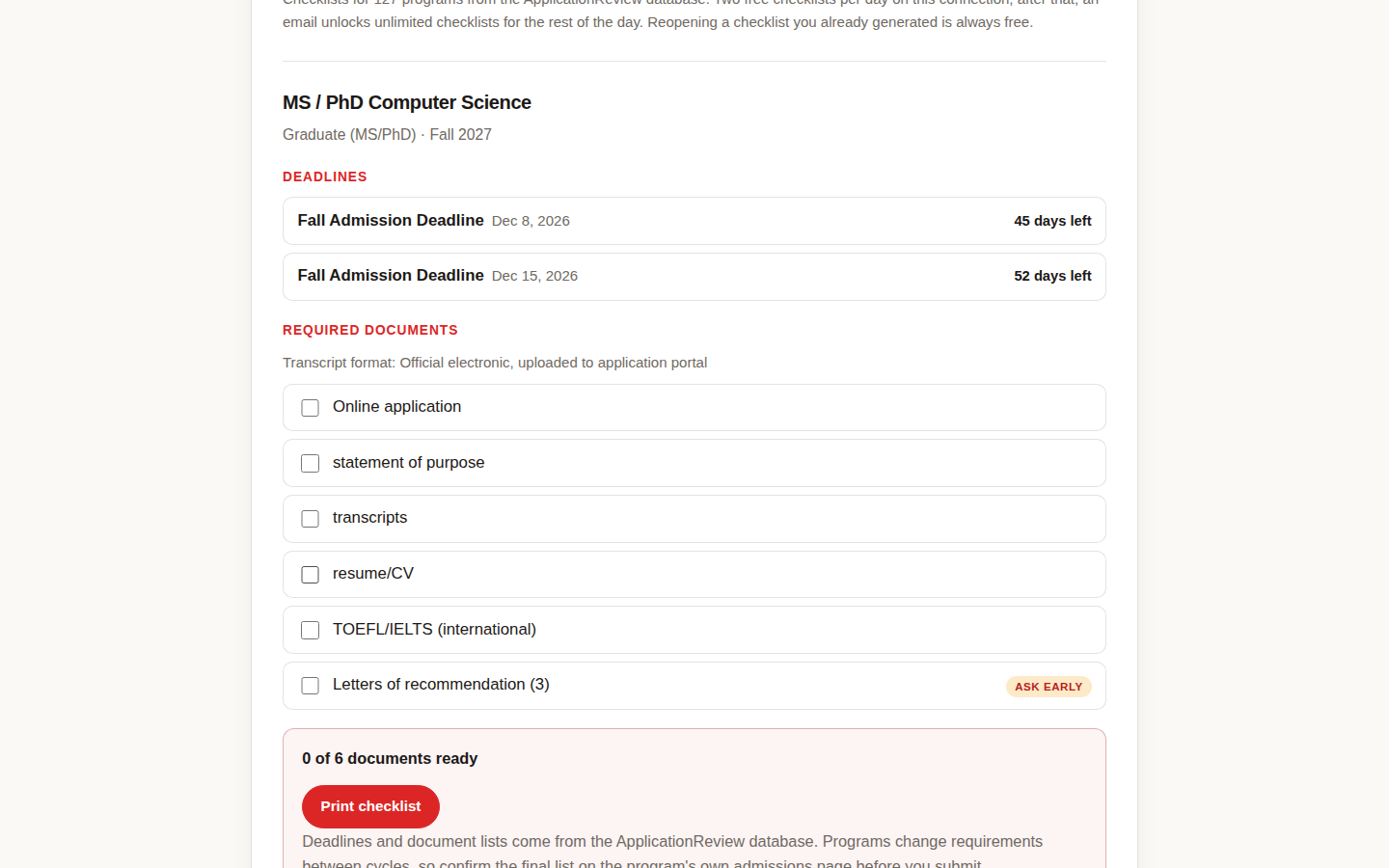
A timeline only helps if it is attached to your actual programs and their actual dates. TheDocCheck generator turns any program on your list into its own checklist: deadlines in order, documents and letters itemized, ready to tick off month by month. If you are comparing tools for the tracking job itself, our roundup of college application organizer apps covers the options honestly, including where a simple checklist beats a full app.
Ten months, two crunches, one list. The seniors who look calm in January are not faster workers. They are the ones whose September and October went to the tasks January depends on.